The Unfinished Story of a Half-Acre on Chimborazo Hill
September 7, 2026
I came across this story a couple of years ago because of a newspaper article I found that was published in the Richmond Times-Dispatch in 1902. Though I have done quite a lot of research, I do not have the time nor the academic qualifications to finish the work. I believe it could become a book or at least an academic article. I am willing to turn over all my research to anyone who might be interested in furthering it.
Here is the gist of her story. Following is an outline and some additional notes. Please contact me at the contact button below if you wish to follow up.
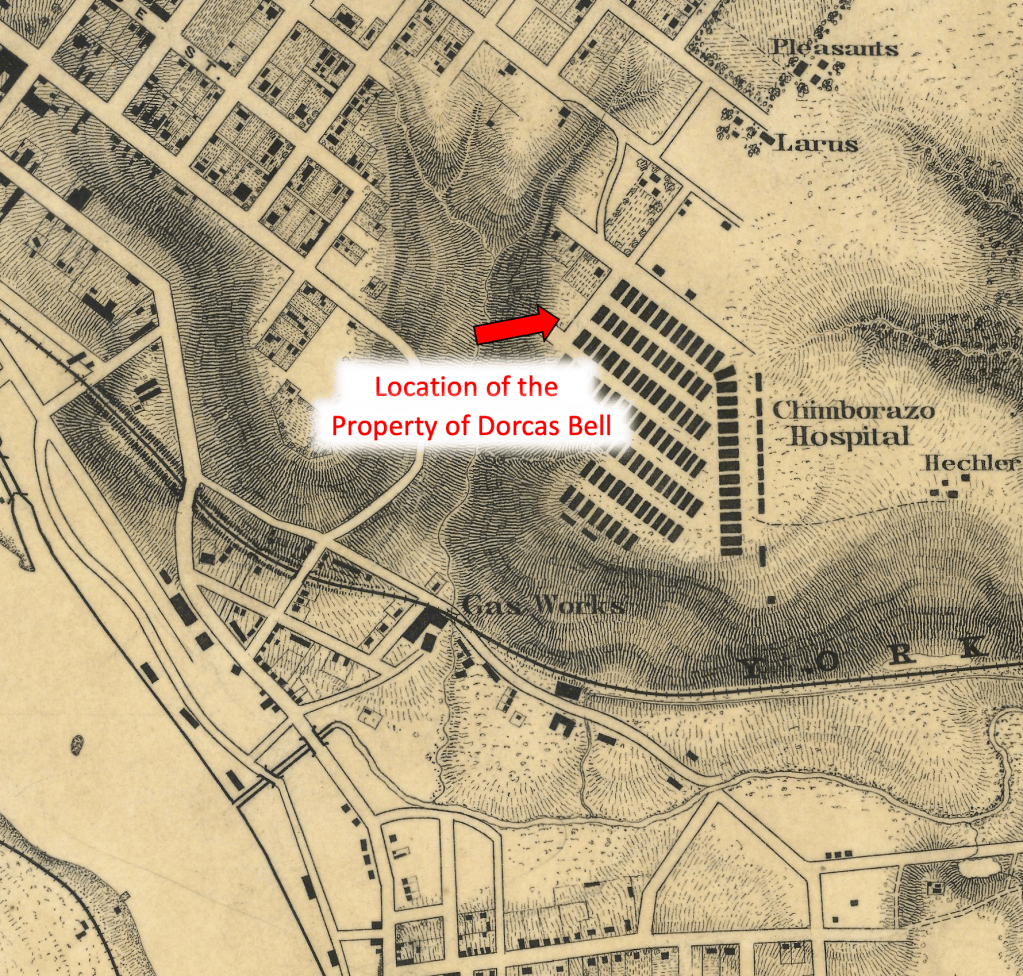
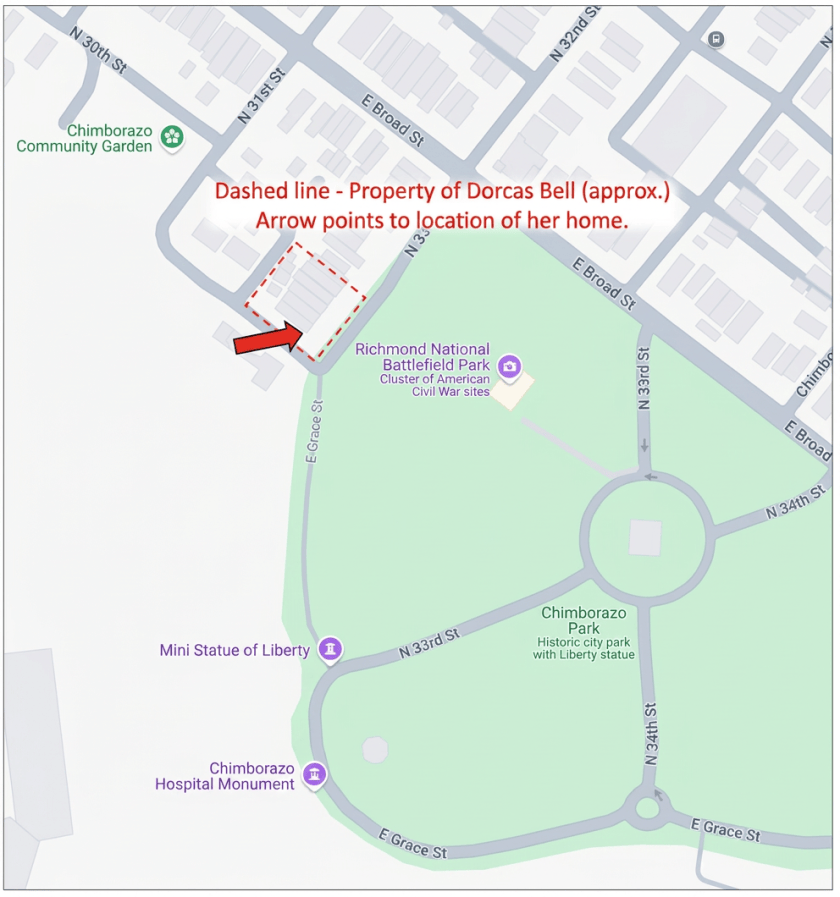
Dorcas Bell was born free in about 1792 in Virginia’s Lancaster County, and in 1825 purchased a ½ acre plot of land at 32nd and Grace, adjacent to today’s Chimborazo Park. She built a small brick home there and sold milk for a living. She died just prior to the onset of the Civil War and was buried under an apple tree in her yard. Though I am not positive, I think she may have been the only free-born Black woman to have bought property in Richmond – others I am aware of were previously enslaved and were given money or property at the time of their emancipation.
Dorcas’s story continues in 1902, when a set of heirs filed suit in Richmond against Joseph Allard, a businessman in town, who had bought the property in 1884 and built several townhomes on it, making a tidy profit. These heirs maintained that James Bell, Dorcas’s grandson, had inherited the property, and his will had left the property to them.
But even before that, perhaps starting as early as 1886, James had initiated lawsuits saying that he owned the property and not the parties who had sold it to Allard (those parties were also James’s relatives). There were many twists and turns to these lawsuits, which went on through many years, but one of the most interesting is the question as to whether James could have legally inherited the property since he was enslaved at the time of Dorcas’s death. Dorcas was free, but her son, who was James’s father, married an enslaved woman, making James enslaved at birth. He was emancipated by the advent of the Civil War.
It is this concrete example of the power of the laws of slavery continuing to affect lives through four decades after the Civil War which was of particular interest to me.
The documents of the 1902 lawsuit, a federal case, are stored in the National Archives. I have a copy of them which I can provide to anyone interested. The 1902 press coverage is also available. I have not learned exactly why the suit eventually petered out, but I think it may be because the heirs who were suing had died.
The story about who the Allards were, which briefly mentions Dorcas Bell, can be found here on my website (download the PDF).
Additional Notes:
This is what I have begun to piece together, and there are obvious gaps. I believe many of them can be filled with additional research.
- Dorcas Bell, a Black woman, was born free in about 1792 in Lancaster County, Virginia. She married William Lightborn in 1806. Lightborn, born about 1786, was emancipated by Jesse Conway Ball of Lancaster County in 1790.
- Though I have no direct evidence to support it, I believe Lightborn may have become an oysterman or perhaps worked on merchant ships. This was one of the more highly paid jobs for free Black men at the time and he lived in an area where this was common.
- Sometime before 1825, Dorcas moved to the Richmond area. Lightborn was almost certainly out of the picture at this point.
- On March 26, 1825, Dorcas paid $50 for ½ acre of property at today’s 32nd and Grace (adjacent to today’s Chimborazo Park) from John A. Smith, a minor member of a fairly prominent White family in Richmond. The land at the time was in Henrico County but was annexed into the city in 1867. She obtained the property under the name Dorcas Bell. I have found no obvious link between Dorcas and Smith.
- The 1850 census (Dorcas would have been around 58 years old) has Dorcas living on the property at today’s 32nd and Grace (the location was not provided on the census, but other documentation shows this is where she was).
- Disputes on Dorcas’s property had arisen as early as after 1833, complicated by several factors. One of these was that Dorcas did not pay delinquent taxes at several points in time (in 1833, she owed 4 cents in taxes).
- I believe Dorcas only had one living child, a son, Thornton Bell. (African American children often took the names of their mothers because it was from them that their status of free or enslaved derived.) Thornton married Ella, an enslaved woman.
- Thornton and Ella had a son, James Bell. Because of the status of his mother, he was also enslaved. When James was about 8 years old, Thornton “went to sea” and was never heard from again. Ella reared James at her and James’s slaveowner’s home near Chimborazo Hill, but when James got old enough to be hired out by his owners to Mayo Tobacco Factory, he often visited or stayed with Dorcas at her home at 32nd and Grace. Dorcas had a small brick home on the half-acre she owned there: it likely faced Grace Street. It is described in court documents as one floor with an attic above it and a shed behind it.
- James Bell married Selina (last name unknown). She was originally enslaved to a Quaker couple but was emancipated by them. I’m not sure if he married her while she was enslaved or after she was free. They had three living children who I believe were all born after Selina was emancipated, and therefore they would have been free as well.
- Dorcas apparently sold milk for a living, indicating that she may have used the property as a small dairy operation.
- Dorcas died some months or years before the onset of the Civil War. She was buried under an apple tree on her property.
- James and his family with Selina apparently continued to live on the property after Dorcas’s death. It was not uncommon for enslaved persons to live elsewhere than their owners, particularly if they were hired out as James, it is known, was. Dorcas did not have a will, but the lawsuit contends she indicated to family members and others that she wanted to leave the property to James, who would have been her oldest, direct, living descendent. In a White world, this would have happened. James’s status as enslaved, however, made it questionable as to whether or not James could inherit the property.
- James and Selena became estranged, and James was also estranged from his children.
- There are other details of what went on with the involved families and property after the end of the war, many of which I have not sorted out, but fast forward to 1884 when the property, with what turned out to be a muddy title, was conveyed to Joseph Allard, a businessman in town. After Allard bought the property, he built several brick townhomes on the property, which are still there today, and he and his adult son lived in two of them (at 200 and 216 North 32nd, respectively), selling the others for a tidy profit. I’m sure Dorcas’s house was torn down during this time. There appear to have been more than one legal action involving the property, starting as early as 1886, when James Bell initiated a lawsuit saying that he, Bell, owned the property. Bell died in 1899 before the suit was resolved, and the matter was taken over by the heirs named in his will (his siblings rather than his estranged children). There are many twists and turns in the lawsuits over the property which lasted over the course of more than a decade. One of these is whether, since James was enslaved at the time of his grandmother’s death, was eligible to inherit the property. The upshot, however, was that Allard’s heirs (Allard had also died in the meantime) were finally ruled the legal owners and the Bell heirs who had lastly sued, received no recourse.
Many interesting details about the lives of freemen/women and enslaved men/women and how they interacted were revealed in the papers about the prosecution of James’s case, and others are likely to be revealed. There are some details of interaction of people involved with the story and Chimborazo hospital during the war.
One interesting aspect of the story is the early purchase of land in Henrico County, today inside Richmond city limits, by an African American woman. While I do not have many details about Dorcas herself, I can put bits and pieces together about what her life would have been like from the information I do have as well as what it was like for other Black women in her circumstances of the time, using as sources newspaper articles and court cases as well as other published research, particularly that of Suzanne Lebsock who in 1984 wrote the wonderful Free Women of Petersburg in 1984.
The first documented Black in the Richmond area to become a homeowner is Abraham Peyton Skipwith in 1793. His house is being restored as part of the current JXN (Jackson Ward) project.
I have put together a document which has all the information about Black home ownership that Mary Wingfield Scott published in her two books published in 1941 and 1950 on old houses and old neighborhoods of Richmond. She derived the fact of Black ownership from deeds; she had gone through all Richmond deeds in the course of her historical work on house histories. Her 1941 book focused almost exclusively on homes owned by Whites. Her 1950 book, written when she recognized much of Jackson Ward was going to be lost to the construction of the interstate highway, has more information on Black ownership. Wingfield Scott did not mention Dorcas Bell in either her 1941 or 1950 books, however. Dorcas was not identified as Black, or as a free woman, or by any other language which would have identified her as African American in the 1825 deed of sale of the house near Chimborazo that she purchased, and so Wingfield Scott would not have realized in her deed searches that the sale had been to a Black woman. Also, Bell’s house was torn down sometime after 1885, and though Wingfield Scott may have come across the news reports of the subsequent lawsuits regarding the property which did identify Dorcas as a free Black woman, Wingfield Scott’s interest was in historical houses still standing.
Possible alternative spellings for Bell: Beale, Ball. Possible alternative spellings for Lightborn: Lightburn, Lightburne. Alternative spellings for Dorcas: Dorcus, Dorsey, Darkey.
Coincidentally, there was another Dorcas Bell in Lancaster County. She was White, born in approximately 1741 and died in 1774. She married Samuel Love in 1759 in Augusta, Virginia. Also see: from pg. 368 of Married Well and Often: Marriages of the Northern Neck of Virginia, 1649-1800 (accessed on ancestry.com): WEAVER, John & BELL, Dorcus; b. 10 Jun 1789; Elijah WEAVER (sec.); MLB WC. (Abbreviations: “b.” = date of the bond; “sec.” = person who provided the paid security for the marriage.)

