A Story of Old Wealth, New Immigration — and Horse Racing
Joseph Salotti had received his naturalization papers in December 1906, grazie a dio, because the new Richmond City ordinance required all men applying for liquor licenses in 1907 to be registered voters — in other words, U.S. citizens. He counted himself lucky: the naturalization process had taken three years, and he knew of other saloon owners for whom it was too late. The new law had also increased the license fee, but Joseph had managed to borrow the mandatory $500 (about $16,000 in 2023 dollars), a sum that he tried not to think about. He had been careful to fill out the license application so nothing would be found amiss, and he had delivered it before the deadline. He believed he would be found to lack nothing in the area of being a person of good moral character and reputation, as the new ordinance required.
Joseph, known as Giovanni to his family and even George in some of the anglicization versions of his name, had done all that, but he had no control over the last wrinkle: the new ordinance also reduced the number of saloons that would be permitted in the city to 150, down from the 264 granted the previous year.
The licenses were to be announced today, February 21, 1908, so Joseph had been watchful for the newsboy who sold the afternoon papers at the busy corner of Brook and Broad. Stakes for Joseph and his young family were high. He not only made a good living as a saloon keeper, but they lived above the saloon and would lose their home if he lost the business.
Before the newsboy had put down his bundles, Joseph was there ready to exchange the penny in his hand for the paper. He moved only steps away before quickly skimming the explanatory paragraphs on the front page and turning to page three where the names of those who had been granted licenses were listed. The names weren’t in any particular order, so it took a minute.
His heart sank. His name wasn’t there. He moved on to the next section of the article, hoping for a mistake. But it was clear. Under the heading, “No License for the Following,” was: “G. Salotti, 303 Brook Avenue.”
(This introduction is an imagined scenario of Sallotti’s reaction to the factual events of the 1907 Dabney Ordinance put forth by prohibitionists.)
April 7, 2024
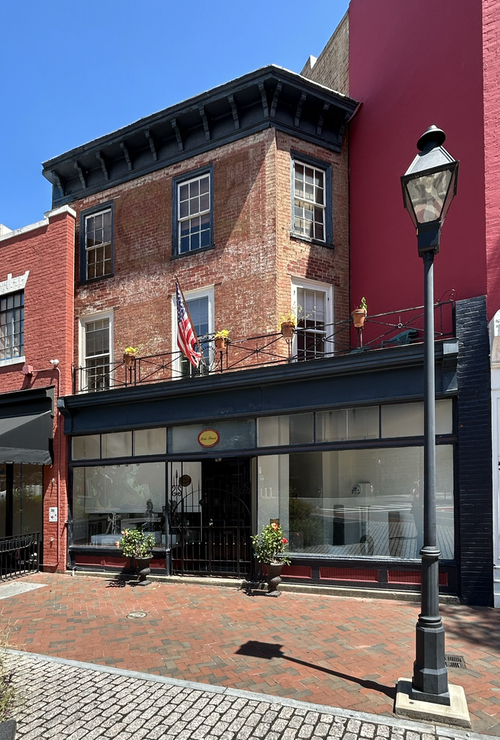
The building at 303 Brook is easily identifiable today because it is where the Maggie Walker statue stands. The building itself sits among others along the block that have unconventionally angled façades that reflect past developers’ efforts to try to maximize their frontage against the three roads that converge there: Brook Road, Adams Street, and Broad Street. The imperfect, nonlinear aspect gives the street a special charm.
The building’s story begins in the earliest days of Richmond, surfacing names of men who were among the very first to shape the city – men who, more often than not, either earned their wealth or could trace their wealth through the pre-war enslavement of African Americans. It is also a story of men who went broke. It is the already well-documented story of European immigration to the Jackson Ward area of Richmond but also drills down to how the American dream was sometimes snatched away. It reveals the story of a swashbuckling engineer who built railroads all across the South and also of his son who was enamored by bicycles when they were all the rage in the 1900s … and then he discovered the sport of horse racing. Harder to find are the narratives of the occasional woman, breaking from the confines that turn-of-the-century society imposed on her, who nevertheless contributed to the narrative. African-American Richmonders also thread through this story occasionally. The story, finally, of 303 Brook is that of the intersection itself that has been vital to the commercial development of the city for over two centuries.
For the complete story of the building, click here for the PDF:
History of the Building at 303 Brook Road, Richmond, Virginia
To contact me, scroll down to the form at the bottom of this page.
Following (for search purposes) are names of persons in the narrative (downloadable PDF with link above).
- Joseph Salotti (aka Giovanni, George, Salatti)
- Marquis de Lafayette
- Dr. William Foushee (mayor)
- Patrick Coutt
- Rev. John Buchanan
- Samuel Mordecai
- Richard Young
- Robert G. Scott
- John G. Williams
- Frederick Ida
- Thomas Maure (possibly Maury)
- Mary Ann Williams
- Elizabeth Lumpkin
- George Timberlake
- Michael Murphy
- Glazebrook & Thomas
- Felix Mathews (possibly Matthews)
- John McWilliams
- Dr. R. M. Pulliam
- John A. Glazebrook
- Mrs. A. Smith
- C. T. Davis
- J. N. Thacker
- Henry Dean
- John E. Kelley
- Peter (enslaved)
- Thomas Barham (possibly later spelled Barnham)
- Richard S. Glazebrook
- William J. Thomas
- Larkin W. Glazebrook
- Sarah E. Thomas
- George Thomas
- Mary E. Glazebrook
- William H. Glazebrook
- Eliza R. Glazebrook
- Joseph J. Pleasants
- George Lumpkin
- Joseph Millhiser
- Louisa Millhiser
- Moses Millhiser
- Robert F. Lumpkin
- Arnold J. Spotswood
- J. Carter Wharton
- Benjamin Gilham
- Rosalie Millhiser
- Michael H. Irvin
- (First Name Unknown) Pollock, City Council member
- Bridget Kelly Irvin
- Robert H. Temple
- Col. Benjamin Temple
- Molly Brooke Baylor
- Lucy Ann Crouch Temple
- John T. Howard
- James Douglass (aka Douglass)
- John Krouse (aka Krause, Krouz)
- Adam Krouse (aka Krause, Krouz)
- Andrew Fontanesi
- G. Carbune
- Giovanni Castelvecchi
- John Twohig (Twig) Temple
- Captain Cardon
- Lunete, the Flying Lady,
- President Theodore Roosevelt
- Bill “Bojangles” Robinson
- Robert Slaughter
- Nina Rosalie Davin
- Henri Davin
- Odille Marie Pavon Davin
- Charles Pardini
- E. L. (Edgar Leonard) Delaney
- Lucy L. Temple
- L. B. Gunn
- R. W. Gunn, Jr.
- Joseph Wasserman
- Charles L. Fleet
Other search terms: Richmond, Virginia, Dabney Ordinance of 1907 (prohibition), saloon, Brook Road, Brook Turnpike, Brook Avenue, annexation, Brook Turnpike Company, Blood Field, Newport News, James River Ferry at Manchester, St. John’s Church, French Huguenots, American Revolution, slavery, enslavers, enslaved, Chez Foushee, Foushee Street, survey, Deep Run Turnpike, old Rope Walk, Marshall Street, Richmond of 1850, E. Sachse & Co., Adams Street, “Richmond, Fredericksburg, and Potomac Railroad,” gas lights, Lafayette Boarding House, Storm King trial, war substitute, grocery, Civil War, Confederacy, peninsular campaign, economy, eminent domain, plat map, German (Bavarian) immigration, dry goods, Jews in Richmond, pardon, slave trade, Lumpkin’s Jail, Shockoe Bottom, cabinetmaker, gunsmith, shoemaker, fire, Irish immigration, Great Famine, real estate investment, bankruptcy, Hollywood Cemetery, Jay Cooke & Co., French and Indian War, Revolutionary War, tobacco farm, Presquile, King William County, Spotsylvania County, “New Orleans, Jackson, and Great Northern Railroad,” “Atlanta and Great Western Railroad,” “Louisville and Nashville Railroad,” “Richmond and York River Railroad,” engineer corps, Trans-Mississippi District, Nitre and Mining Corps, Mexican nitre, Missouri River Bridge, “Chesapeake and Ohio Railroad,” “Georgia, Carolina, and Norther Railway,” Great Seaboard Air Line System, “Temple, Georgia,” omnibus, sidewalks, electric street lights, African-American riot (demonstration), Jim Crow, Masonic Temple, oyster dealer, fish dealer, fruit dealer, Germany, Italy, Romania, Virginia Union University, horse fountain, National Humane Alliance of Maine, bicycles, Meyer Store fire, Franco-Prussian War, horse race, Hilly Hibbs, swayback, Amanda Thorp, Dixie Theater, confectionary, segregation, Russia, Slovak, Hippodrome Theater, Sigmund’s Shoe Shop, Great A&P Tea Company, Acme Window Service Company, Owen Sign Company, Rex Lunch Room, Jackson Ward, Home Furniture Corporation, Dixie Transfer Company, Colonial Piano Company, Winchester, Cuba, Ginter Park, Goochland, Fluvanna County, Ashville, North Carolina, Liberty Meat Market


 Richmond Narratives