Last updated: November 22, 2025
The resources below, most of them easily accessible online, will be useful for those researching in Richmond and Henrico County, Virginia, but may be helpful to others living elsewhere. In doing an exhaustive house history project, none of these steps are “one-and-done.” As you find out more names and more information, you will want to do other searches on the other names and other information you find. Even in the case of deeds, you may find it necessary to investigate a neighboring address or another property owned by a person who once owned yours. In general, you should check everywhere for every name and address that comes up; you will be surprised at what you can find by being ridiculously thorough.
I am happy to answer questions, contact me here.
Index to items below:
- Property Databases for Richmond City and Henrico County
- Newspaper Searches
- Where to Find Photos of Your House
- Richmond Historic Districts
- Tips and Tricks for Doing a Deed Search
- Richmond City Directories – What They Are and Where to Find Them
- Other Searches on People
- Databases of Scanned Old Books and Government Documents
- Useful Maps
- Ideas and Resources at Local Libraries
- Six-Generation Family Tree Template/Form
Online Property Databases for Richmond City and Henrico County
A good first step in researching your house’s or building’s history is to check the online databases at the appropriate property office. This is easy to do online.
If your house is currently in the Richmond City limits…
- Until about November 2025, it used to be possible to find more information on a given house or building in Richmond online, but now it appears it is only possible to find the current property owner. However, there is a telephone number which can be called, and perhaps the clerks will provide what you used to be able to see. The property search site which has the telephone numbers listed is here.
- Hopefully, clerks will be willing to provide you with what the city considers the “year built” is for the property (this is often incorrect, but it gives you a place to start).
If your house is currently in Henrico County (or was in the county before it was annexed at some point)…
- Click on the link for the Henrico County property office here.
- Search on your address.
- You should see your property come up in a list. Click on the pencil under the “Select” column next to your property.
- Click on the button about 2/3 down on the right that says “Additional Transfer & Assessments.” You may see transfer histories that go back in time to around 1990 or earlier.
- For older information, a “property card” may be available. To see the old property card, if it exists, click on the button near the top that says “Old Property Card.” I have seen property cards – with photos of houses – back to the 1920s. It may take some sleuthing, but you may get a general idea about how old your house is, previous owners, etc., on the old property card.
Newspaper Searches
A good second step, which is easy, is to do an online search for newspaper articles about your property. You can do this here, online, through the Library of Virginia website. Run your property address through, using the different forms it might have taken in a print article; for example: 2307 North 22nd, 2307 N 22nd, 2307 North Twenty-Second, 2307 N Twenty-Second, 2307 North 22d. You may learn a lot about your property, including possible sales, who bought and sold it, or even a photograph, etc. You can then do searches on any names that come up.
Where to Find Photos of Your House
There are a number of places you can look for old photos of your house. The nomination forms of the various historic districts (see Richmond Historic Districts section below) is a good place to start. The books by Mary Wingfield Scott, Houses of Old Richmond (1941) and Old Richmond Neighborhoods (1950), have a number of photographs — a revised version on the latter book is available here as a PDF, and the former can be found in the Valentine Museum, the Richmond Public Library, and the Library of Virginia. Two other books of photos of Richmond architecture which are likely out of print but available at the libraries are Paul S. Dulaney, The Architecture of Historic Richmond (1968, 1976) and Historic Richmond Foundation, Architecture in Downtown Richmond (1982). Church Hill, the Fan, and other neighborhoods have published books about the homes in their areas, and they are also available in the libraries. For Henrico County, this downloadable PDF is a good go-to for county sites. Other photographs (and accompanying information) may be found in the following institutional locations (search by street address as suggested in the Newspaper Searches section above). Be sure to contact the institutions involved if you get a “hit,” as they may be able to send the information to you — or may let you know, for example in the case of insurance policies found in the Library of Virginia — that what is available online is better seen, and has more information, in person.
- The Valentine Museum (search their “collections”)
- The Library of Virginia (search the catalog)
- Virginia Commonwealth University, Cabell Library
Richmond Historic Districts
There are two different kinds of historic districts in Richmond. There are the National and State Historic Districts and the City Old and Historic Districts. Check the map here to see if your house is in one of them. If so, do a general Google search on your district (example: “Church Hill North Historic District”) and poke around the results to see what you can find. Don’t overlook any nomination forms you may find – they hold a wealth of information both on the area and on individual houses, including photographs. If you want to search Google specifically for the nomination form, just add those two words to your district name in the search.
Tips and Tricks for Doing a Deed Search
The most rewarding, but most difficult, thing to do when you are researching your house’s history is to do a title search on your property. This will provide you with the deeds to your house, or the land which your house sits on, for as far back as a couple of hundred years. A lot of information can be found in the old deeds, some of it quite surprising. For tips and tricks about doing a deed search at Richmond City or Henrico County property offices, click here.
Richmond City Directories – What They Are and Where to Find Them
A two-page PDF found here provides information about where to find Richmond City directories locally and online, as well as what kind of information can be found in them. These directories were published from 1845-2002. The Valentine Museum has a collection of city directories, but they are not listed in the PDF yet; I hope to add them in the future. Using the city directories online at Ancestry.com can be tricky, and it may be more useful for most users to stop by these institutions and use the hard-bound copies.
Searches on People
The genealogical sites ancestry.com (fee-based) and familysearch.org (free) are the logical places to start. Ancestry.com may have a trial period which you can use for a few days for free, otherwise see the Ideas and Resources at Local Institutions section below for ways to access it at no cost. Findagrave.com can yield surprising information and should not be overlooked; however, the search is not very flexible — it looks for exactly what you type. Museum and library holdings may have surprising information in their files. Don’t overlook searching in all of these institutions (at minimum). If you find links about your person to other cities and counties, reach out to their historical societies and ask for additional information.
- Library of Virginia (catalogue search)
- Valentine Museum
- Virginia Museum of History and Culture
- James Branch Cabell Library, Virginia Commonwealth University
- University of Virginia Library
- Swem Library, William and Mary University
- Boatwright Library, University of Richmond (esp. if your person has a UR connection)
Databases of Scanned Old Books and Government Documents
These are my top “secret” sources. These databases are online and free, and sometimes you can find the most amazing stuff. Run names and even addresses through them.
- Google Books (brings up stuff that isn’t readily apparent through a Google Search, but don’t overlook Google searches either!)
- Internet Archive (search “text content”)
- HathiTrust (if you can’t access the documents, ask at the Library of Virginia)
Useful Maps
The first map below, of Richmond annexations, will tell you when your property was annexed into Richmond; prior to that date, you should investigate Henrico County resources. Maps after the first one are listed in chronological order. A homeowner is well-served to locate where their house was, or would have been, in nearly all of these maps. Asterisks (*) indicate maps which are particularly well-detailed and depict the location of actual buildings and houses in Richmond; some even provide homeowner names.
- Map of Richmond City Annexations with Dates (Richmond GeoHub). This map is useful for determining when a property was included in Richmond City limits. (The City of Richmond was officially part of Henrico County until 1842, when it became a fully independent city.)
- 1735 (or 1742) Plan of Richmond, William Byrd (Library of Virginia)
- 1809 Plan of the City of Richmond, Richard Young (Library of Virginia)
- 1817 Map of Richmond, Richard Young (Library of Virginia)
- 1835 Plan of the City of Richmond, Micajah Bates (Library of Virginia)
- 1848 Plan of Richmond (Henrico County), Manchester & Springhill, Virginia, Charles S. Morgan (Library of Virginia)
- 1853 Smith’s Map of Henrico County (Library of Virginia)
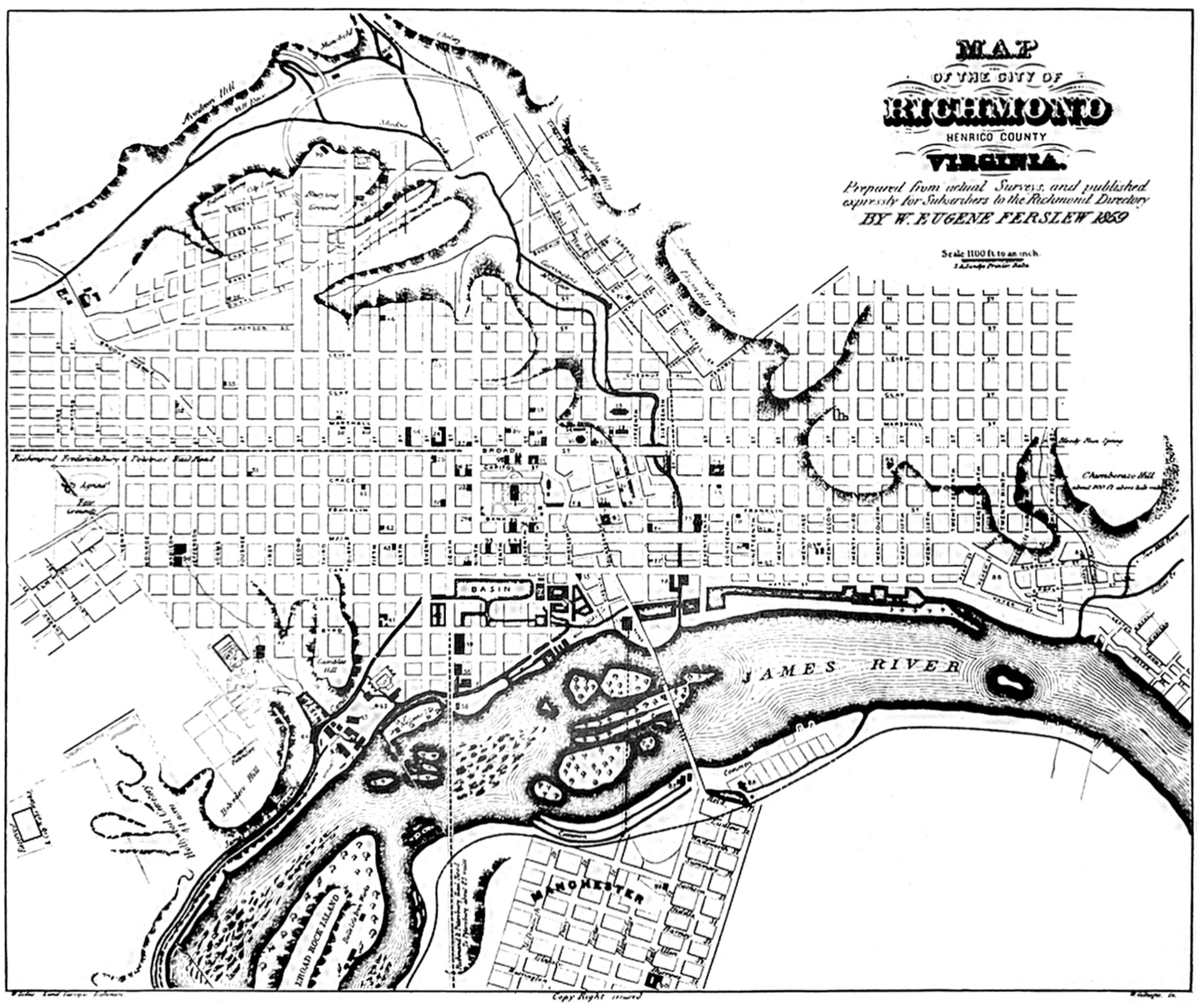
- 1859 Map of the City of Richmond, W. Eugene Ferslew, found in Michael B. Chesson, Richmond after the War, Virginia State Library [today the Library of Virginia], Richmond, Virginia, 1981.
- 1864 “Historic Richmond and Vicinity,” Albert H. Campbell, U.S. Army Corps of Engineers, reproduced in 1920[?]. Detail of immediate Richmond area. Full map located here (Library of Congress).
- 1864 Map of the City of Richmond, C. Bohn (Library of Congress).
- *1866 Map of Richmond and Manchester (top half of Richmond) (bottom half of Richmond), Peter Michie, U.S. Army Corps of Engineers (U.S. National Archives [NARA])
- 1877 Illustrated Atlas of the City of Richmond, Va., F. W. Beers (Library of Congress)
- *1886 Sanborn Insurance Atlas of Richmond and Manchester, Sanborn Map Company (Library of Congress)
- *1889 Baist Atlas of Richmond, Va., G. Wm. Baist (Virginia Commonwealth University, James Branch Cabell Library, Digital Collections)
- *1895 Sanborn Insurance Atlas of Richmond and Manchester, Sanborn Map Company (Library of Congress)
- *1899 Map of Principal Business Section of Richmond, Va., Henning and Baker (Library of Congress)
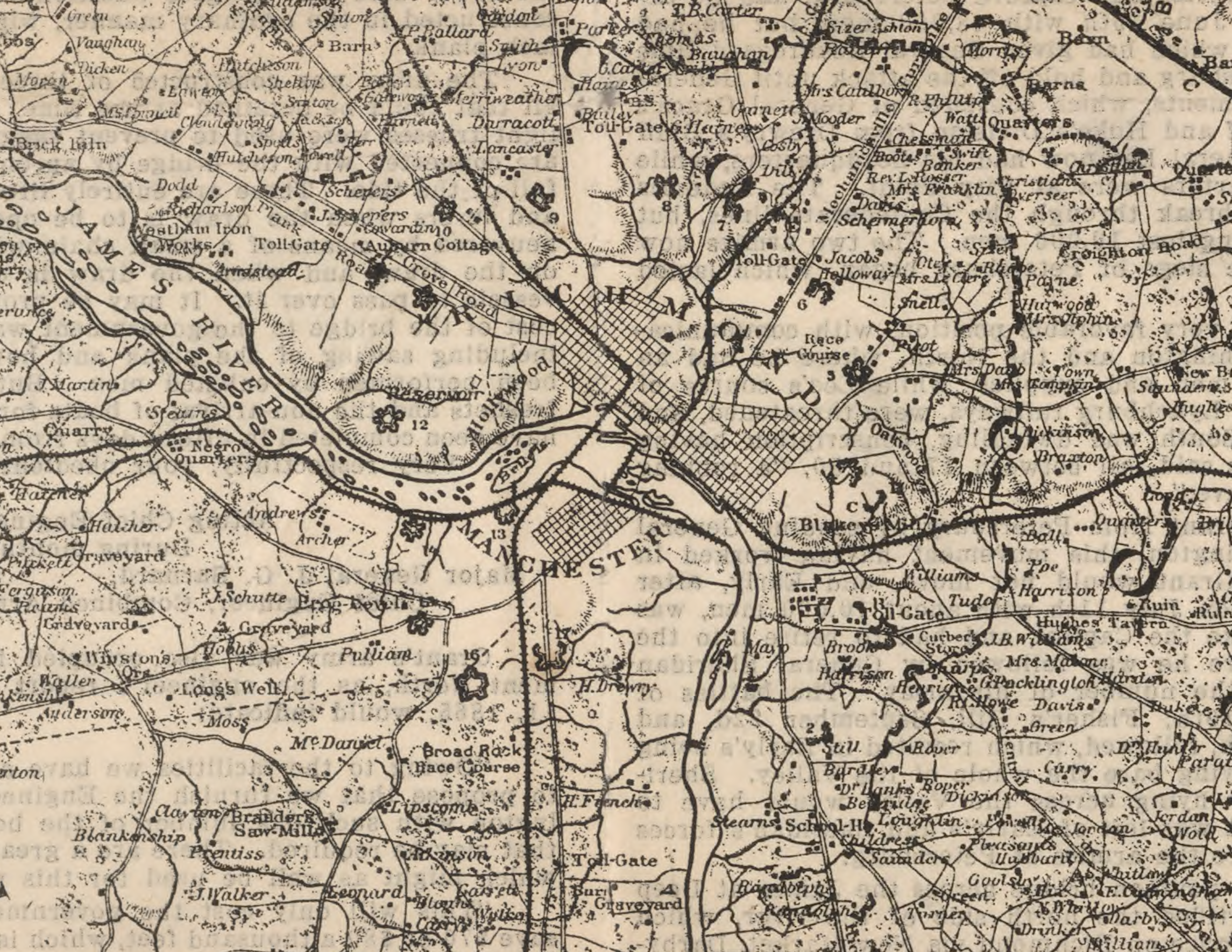
- 1901 Map of Henrico County, Va., T. Crawford Redd & Brother (Library of Congress)
- 1901 Streetcar Map of Richmond, Virginia (University of Texas, Austin, Libraries, Perry-Castañeda Library)
- *1905 Sanborn Insurance Atlas of Richmond, Sanborn Map Company (Library of Congress)
- *1908 Sanborn Insurance Atlas of Richmond (supplement, has only some suburban areas), Sanborn Map Company (Library of Congress) [I have been unable to locate a copy of the entire atlas.]
- *1911 Map of Henrico County, Virginia, T. Crawford Redd & Brother (Library of Congress)
- *1916 Map of Henrico County, Virginia, T. Crawford Redd & Brother (Library of Congress)
- *1919 Sanborn Insurance Atlas of Richmond, Sanborn Map Company (Library of Congress.
- *1919 Sanborn Insurance Atlas of South Richmond, Sanborn Map Company (Library of Congress). Several dates (1942, 1945, 1947) on the copy of this atlas show it is a later re-publication, likely with revisions.
- 1923 Redlining Map of Richmond, Federal Home Loan Bank Board (U.S. National Archives)
- *1924 [1951?] Sanborn Insurance Map, Sanborn Map Company (Library of Congress). Republished 1951 with revisions. Vol 1 of 3; this is most of the City of Richmond. It is difficult to tell what revisions were made and whether the map more accurately represents Richmond in 1924 or 1951.
- *1925 Sanborn Insurance Map, Sanborn Map Company (Library of Congress). Vol 2 of 3; this is most of the City of Richmond. There is no mention that this volume was a revision.
- *1925 [1951?] Sanborn Insurance Map, Sanborn Map Company (Library of Congress). Republished 1951 with revisions. Vol 3 of 3; parts of the city not included in volumes 1 and 2 including North Jackson Ward. It is difficult to tell what revisions were made and whether the map more accurately represents Richmond in 1925 or 1951.
Ideas and Resources at Local Institutions
I would always additionally write to the contact points provided by these institutions because they are all very helpful and can point you in the direction of their resources much better than I would ever be able to here.
But first, Historic Richmond and the Virginia Museum for History and Culture both have pages with advice on how to investigate house histories and may have information I have not provided on this page.
Library of Virginia – has the Ancestry for Virginians database which is free to Virginians to access online within Virginia (it uses geolocation to make sure). It contains records that Ancestry.com has digitized from LVA collections. Also Ancestry.com and Fold3 (military) databases are available at the library, but they do not provide full access to all services offered by those sites such as building a family tree; you can, however, save copies of records you find to a flash drive you bring yourself or print them on their printers for 25 cents a copy. A full list of LVA databases available to Virginians, some only available at the library and others at home with a library card can be found here. Library cards are free to Virginians; information on how to obtain one is found here. They have an Interlibrary Loan program (when you can’t find a book in a local library) available to cardholders here.
Richmond Public Library – RPL has been expanding the access to their many useful holdings and are well worth checking out (email them to ask questions). They offer on-site access to Ancestry.com to library card holders, but, like LVA, it is searchable access only (you cannot build a family tree on it). They also have on-site access to JSTOR (a digital library that provides access to scholarly articles, books, images, and primary sources.)
Six-Generation Family Tree Form
The form is my gift to you; it is not copyrighted. Download here.
 Richmond Narratives