Formerly Enslaved, He Chose to Fight for His Freedom
February 24, 2025
(This is an edited version of information excerpted from the PDF about the social history of the house at 619 N 23rd, Union Hill, Richmond, Virginia. More details appear in the PDF.)
James Jones of Richmond, a Union soldier, was in Dalton, Georgia, his regiment tasked with protecting the railroad that ferried supplies to General Sherman’s troops in Atlanta. James had heard the rumors that an overwhelming force of Rebs was approaching their position, and that Colonel Johnson would have no choice but to surrender. Any man would be anxious under these circumstances. But James and nearly every soldier around him had a special reason to be apprehensive: they were former slaves.
On March 19, 1859, about a year before the outbreak of Civil War hostilities, a group gathered in Richmond to hear the will of William Hawkins. William’s first concern had been with the care of his wife, Nancy Ann, also known as Anna: “First, I give to my wife Nancy Ann Hawkins for and during her natural life the house and lot in the county of Henrico in which I now reside. I also leave to her for her natural life my negro woman named Agnes.”
His second paragraph dealt with other details, but in the third paragraph he directed the fate of his two other enslaved persons: “… I desire that my executors shall sell my two negro boys named John Jones and James, brothers,” with proceeds going to paying debt and providing cash sums to others who were apparently other close relatives.[1]
Because the African American Jones family was emerging from slavery, it is difficult to learn their history. It is further complicated by their names, Agnes, James, and John Jones, which are very common. However, at least a partial account of what appears to be this family can be re-constructed, most notably including the remarkable story of James’ civil war experience.

The August 21, 1860, Richmond area census (slave schedule) for Anna Hawkins seems to indicate the sale ordered by her husband was delayed. She is shown in that census as owning three enslaved persons, a female aged 37, and two boys, aged 14 and 15 (Figure 1).[2] It does not seem a leap of faith to deduce that these are the same three people listed in William’s will, and, further, that the enslaved female of the census – Agnes, at age 37 – was the mother to the “John Jones and James, brothers,” of the will.
Though their sale may have been somewhat delayed, it seems likely that sometime after 1860 the brothers fell victim to the interregional slave trade of the era. At the time, Richmond was the largest trafficking center for the massive population transfer of enslaved people from eastern Virginia to the sugar and cotton plantations of the Deep South. Even though the Civil War was imminent, it unfortunately cannot be said that John and James were among the last African Americans sold South as slave trafficking despite the hostilities.
There are no known records of the sale of James and John or where they were sent, but they almost certainly would have been sold individually, experiencing first-hand the social and emotional effects of family separation of American slavery – likely first from their mother and then secondly from each other. There can be no doubt that their grief and anger would be profound, severed as they were from all they had known and sent to distant places where they knew no one and had no roots. They doubtless would have heard the speculation of approaching war, and they may have had whispered conversations with other enslaved boys and men who may have said that they would fight if they could. Every step they were forced to take that separated them from what had been their home no doubt strengthened their resolve.
The War Record of James Jones
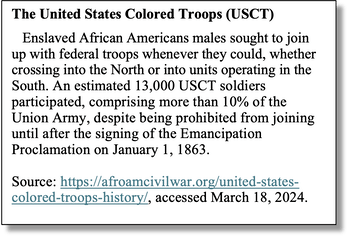
At the age of 18, an age which conforms to that of one of the enslaved brothers listed in the 1860 slave census, a James Jones of Richmond joined up with the 44th U.S. Colored Troops (USCT) Infantry (also known as the 44th USCI), Company E, on June 5, 1864, at Chattanooga, Tennessee. The military records of this James Jones describe him as 5 feet, 5½ inches tall, dark eyes, and black hair. His occupation was listed as “farmer,” which may or may not coincide with his assigned labor in Richmond, but it is nevertheless very likely what James Jones had been doing after he had been sold and transported to a state further south.[3]
The 44th USCI consisted of some 600 soldiers who, like James, were African Americans, runaway slaves who had streamed from across the South to the safety of Federal lines in Tennessee, where Colonel Lewis Johnson, a white officer in Chattanooga, enlisted them.
By October 13, Johnson and his approximately 750 troops were located near Dalton at Fort Hill at the Federal garrison there: the 44th USCI and their white (as was the norm) officers, a few scattered white units which had been attached to Johnson’s command, and another group of white men local to the area who had remained loyal to the Union cause. Though Johnson’s troops had been in the area since mid-September, in early October he and his men were in an especially perilous position. Confederate General John Bell Hood was moving in their direction. Having lost Atlanta to General William T. Sherman, Hood was shifting his Confederate Army of Tennessee – some 40,000 strong – to the north in order to threaten Union supply lines, hoping to draw Sherman away from Georgia’s capital city.
Colonel Johnson gave a detailed after-account of the resulting events.[4] After first relating several skirmishes between his men and Hood’s Confederates that resulted in Johnson’s troops being surrounded by a crushing number of rebel soldiers, he wrote:
“Not believing myself justified in sacrificing the lives of nearly 800 men, … I surrendered the command as prisoners of war … [but] under conditions that the men were to be treated humanely, officers and white soldiers to be paroled, [and] officers to retain their swords and such private property as they could carry. … I was told by General Hood that he would return all slaves belonging to persons in the Confederacy to their masters; and when I protested against this and told him that the United States Government would retaliate, and that I surrendered the men as soldiers [an not as slaves], he said I might surrender them as whatever I please; that he would have them attended to, &c. … As near as I can come at the numbers, the force was as follows: 44th U.S. Colored Infantry, about 600 enlisted men; Company F, 57th Illinois Volunteers, about 50 enlisted men and 2 commissioned officers; third, Company B, 7th Kentucky Volunteer Cavalry, about 50 enlisted men and 3 commissioned officers; one section 20th Ohio Battery, about 20 enlisted men; total 751 men.”
James Jones of Richmond was one of the captured Union soldiers (Figure 2).[5]
Colonel Johnson continued his report:

“The colored soldiers displayed the greatest [willingness] to fight, although all could plainly see what an immense force threatened us and that there was no hope whatever. It grieved me to be compelled to surrender men who showed so much spirit and bravery. … [They contested] the ground as stubbornly as [seasoned] troops. … Although assured by General Hood in person that the terms of the agreement should be strictly observed, my men, especially the colored soldiers, were immediately robbed and abused in a terrible manner. …”
Part of the enforced suffering of the captured Black soldiers meant forcing them to walk barefoot on the sharp stones of the rail bed while engaging in hard labor. According to Johnson:
“[Confederate] General Bates distinguished himself especially by meanness and beastly conduct. … He had my colored soldiers robbed of their shoes … and sent them down to the railroad and made them tear up the track for a distance of nearly two miles. One of my soldiers, who refused to [damage] the track, was shot on the spot, as were also five others shortly after the surrender, who, having been sick, were unable to keep up with the rest on the march.”
To discourage African American men from joining Union troops, the Confederate government in 1863 had legalized re-enslavement or execution instead of following prisoner-of-war protocols should a black man be captured in combat, and Hood and his men carried through on those threats.
Johnson wrote:
“After arriving in the vicinity of Villanow [a few miles southeast of Dalton], a number of my soldiers were returned [to slavery]. … I tried to get the free servants and soldiers in the regiment … released, but to no avail. … Several times on the march [Confederate] soldiers made a rush upon the guards to massacre the colored soldiers [as well as] their officers. …”
Johnson believed Washington should respond:
“In conclusion, I make the request that whatever can be done will be done to secure retaliation, which may in some measure lessen the sufferings of the colored soldiers of the 44th Regiment now in captivity.”
The capture of the 44th USCI Regiment was the largest surrender of African American soldiers during the American Civil War. During their captivity, approximately 250 were returned to slavery with little to no regard to their pre-war status and little to no proof as to the validity of any ownership claims. Another 350 were pressed into Confederate service as personal servants for officers or to work on Confederate fortification projects in Mississippi and Alabama. Many, like James Jones, served out the war as prisoners in places like Columbus and Griffin, Georgia, although where James was specifically located is unknown. When Union prisoners of war were released after the surrender of General Lee at Appomattox on April 9, 1865, they were “sick, broken down, naked, and starved.” [6]
James Jones returned to the regiment in Chattanooga from prisoner of war status on May 21, 1865. By the time an accounting of these former prisoners was made on December 1, 1865, only 125 of them were still alive. James remained with the regiment through October 1866, mustering out at Nashville, Tennessee, as a private. He was paid $3.81 due him. [7]
What happened to this James Jones after the war is not known; no certain information can be found to place him in Richmond after the war.
John Jones
A John H. Jones of Richmond joined up with USCT troops at Piketon, Kentucky, just after the Confederate surrender at Appomattox. John’s age of enlistment, 19, approximates the age he would have been in 1865 if he were the John Jones mentioned in William Hawkins’ will and in the 1860 census (slave schedule) for Anna Hawkins. Records are unclear, but this John Jones apparently saw no action. He mustered out of the regiment on November 18, 1865.[8] On November 11, 1866, a John Jones of Richmond appeared in a Henrico County wedding registry with his mother listed as Agnes Jones (father: Richard Jones). This John Jones was 22, which was the approximate age of John Jones in the will and the slave schedule as well as the John H. Jones who had been with the USCT in Kentucky. He married Laura Jane Starks of Halifax.[9]
[1] 1850 U.S. Census, Slave Schedule, “William Hawkins,” Western District, County of Henrico, July 27, 1850; will of William Hawkins, Mixed Records, Vol 16-17, 1858-1866, Henrico County, July 13, 1858, www.ancestry.com; “Died,” Richmond Dispatch, March 21, 1859. The newspaper notice was an announcement of William Hawkins’ death on March 19, 1859, and noted the funeral would take place from the residence of his son-in-law, “Mr. J. M. Newell, 23rd street, Union Hill.”
[2] 1860 U.S. Census, Slave Schedule, “Anna Hawkins,” Eastern Division, County of Henrico, Virginia, August 18, 1860, (pp. 48-49).
[3] Civil War Records of James Jones, Richmond, Virginia, U.S. National Archives; accessed on www.Fold3.com.
[4] The War of the Rebellion, Series I, Volume XXXIX, Part I – Reports, pp. 721-723 (Washington, D.C.: Government Printing Office, 1892). pp. 721-723.
[5] Civil War Records of James Jones, Richmond, Virginia, U.S. National Archives; accessed on www.Fold3.com.
[6] https://www.slavestosoldiers.org/us-colored-troop-veterans/infantry-regiments/44th-us-colored-infantry, accessed March 17, 2024; Clarence Mohr, “Black Troops in Civil War Georgia,” New Georgia Encyclopedia,
[7] Civil War Records of James Jones, Richmond, Virginia, U.S. National Archives; accessed on www.Fold3.com.
[8] Civil War Records of John H. Jones, Richmond, Virginia, U.S. National Archives; accessed on www.Fold3.com; and https://www.nps.gov/civilwar/search-battle-units-detail.htm?battleUnitCode=UUS0013RI00C and https://www.nps.gov/civilwar/search-battle-units-detail.htm?battleUnitCode=UUS0121RI00C, accessed March 20, 2024.
[9] John Jones and Laura Jane Starks, November 11, 1866, Henrico County (Virginia, U.S., Marriage Registers, 1853-1935, accessed on www.ancestry.com.)
 Richmond Narratives