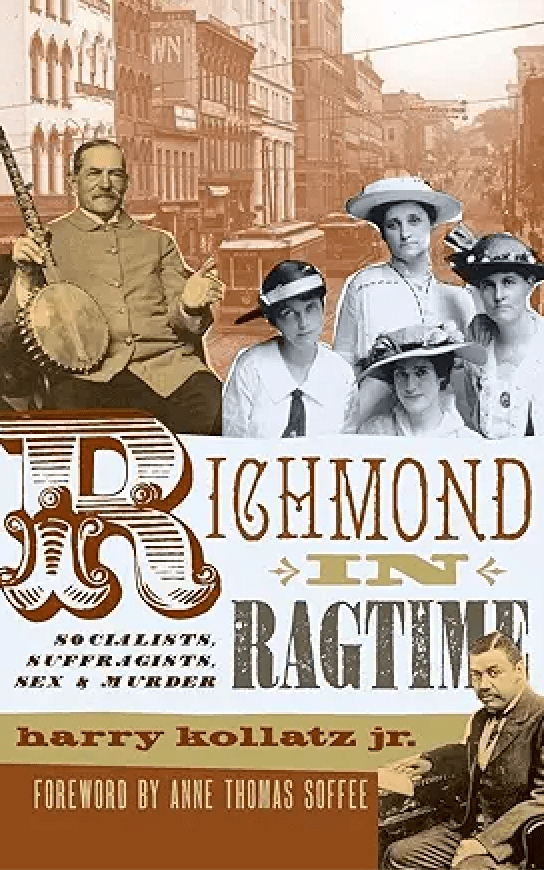
Harry Kollatz wrote a delightful book in 2008 which he called Richmond in Ragtime. Full of fascinating stories of the time, the clever title with the alliterative ring to it perfectly defines the time period about which he was writing — the early 1900s. Today, we think of ragtime with its jerky, syncopated rhythms as cheery, lively music, but some people in that first decade of the twentieth century were less than impressed, perhaps because of the genre’s Black roots. The Richmond Times newspaper in 1900 wrote about ragtime as “musical slang … as demoralizing in its field as slang phrases to language. (The music is) coarse and sometimes borders on the obscene. It is a good thing for people to sing, and we have nothing to say against good popular music, but ragtime is to be discouraged. It does not have a refining influence.”
The Wednesday Club of Richmond, a musical organization of “high character,” according to the Times, was instead presenting “high-class” music that exerted “a wholesome and powerful influence throughout the community.” In so doing, the Club was influencing musical taste in Richmond in such a way that ragtime soon, the Times predicted, would become a thing of the past.
The Times was fighting a losing battle. Even by the time of the Times article, “Ragtime was everywhere …,” a Library of Congress article notes, “–in sheet music, piano rolls, phonograph records, and ragtime piano playing contests, as well as in music boxes, vaudeville theaters, and bordellos. Publishing houses churned out piano rags and ragtime songs at a furious pace.” The musical form would not fade until around 1917 when it began to be replaced by another controversial form of music: jazz.
(Sources: “Rag-Time Music,” Richmond Times, April 28, 1900; Library of Congress, “History of Ragtime,” https://www.loc.gov/item/ihas.200035811/, accessed December 26, 2023.)
 Richmond Narratives